09 April 2026 – need2know
In our second M&A Spotlight edition (Vol. 2), bpv Huegel PE/M&A partner Michal Dobrowolski highlights the “Top 5 Impacts on M&A during Geopolitical Conflicts” – key ways in which geopolitical uncertainty is reshaping today’s M&A landscape, from foreign investment control and regulatory risk to pricing gaps, financing constraints, risk allocation and strategic portfolio re‑alignment. These factors are no longer peripheral. Early regulatory analysis, disciplined risk allocation and sophisticated deal structuring have become decisive for how transactions are executed.
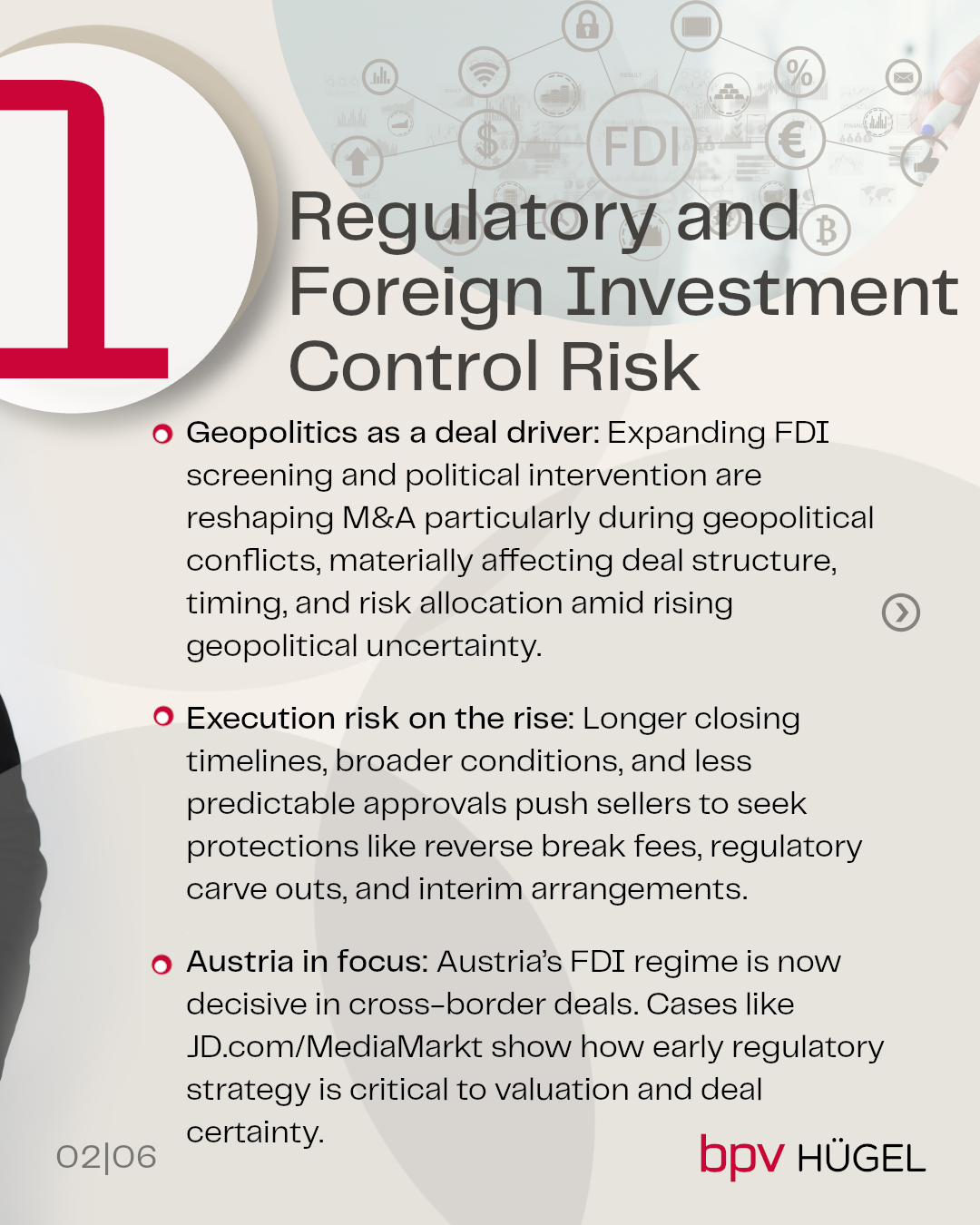
1. Regulatory and Foreign Investment Control Risk
Heightened geopolitical tensions have led to a steady expansion of regulatory scrutiny, particularly through foreign direct investment (FDI) screening regimes and other forms of political intervention. These controls have become a critical deal driver in times of geopolitical uncertainty, materially influencing transaction structuring, timing, and risk allocation.
For M&A transactions, this typically translates into longer closing timelines, expanded conditionality, and increased execution and break risk. Regulatory outcomes are often less predictable, and approval processes may involve multiple authorities with evolving political considerations. In seller‑friendly markets, this has prompted sellers to seek enhanced protection mechanisms, including reverse break fees, regulatory walk‑away limitations, carve‑outs for high‑risk jurisdictions, or hold‑separate and interim operating arrangements to preserve deal certainty.
Austria is no exception. The Austrian foreign investment control regime has become a decisive factor in cross‑border transactions, with the potential to materially delay or even block deals. Recent cases – such as the attempted acquisition of MediaMarkt by China‑based JD.com – illustrate how FDI scrutiny can substantially impact deal feasibility, valuation assumptions, and overall transaction strategy. As a result, regulatory risk assessment and early engagement with authorities have become indispensable elements of M&A planning.
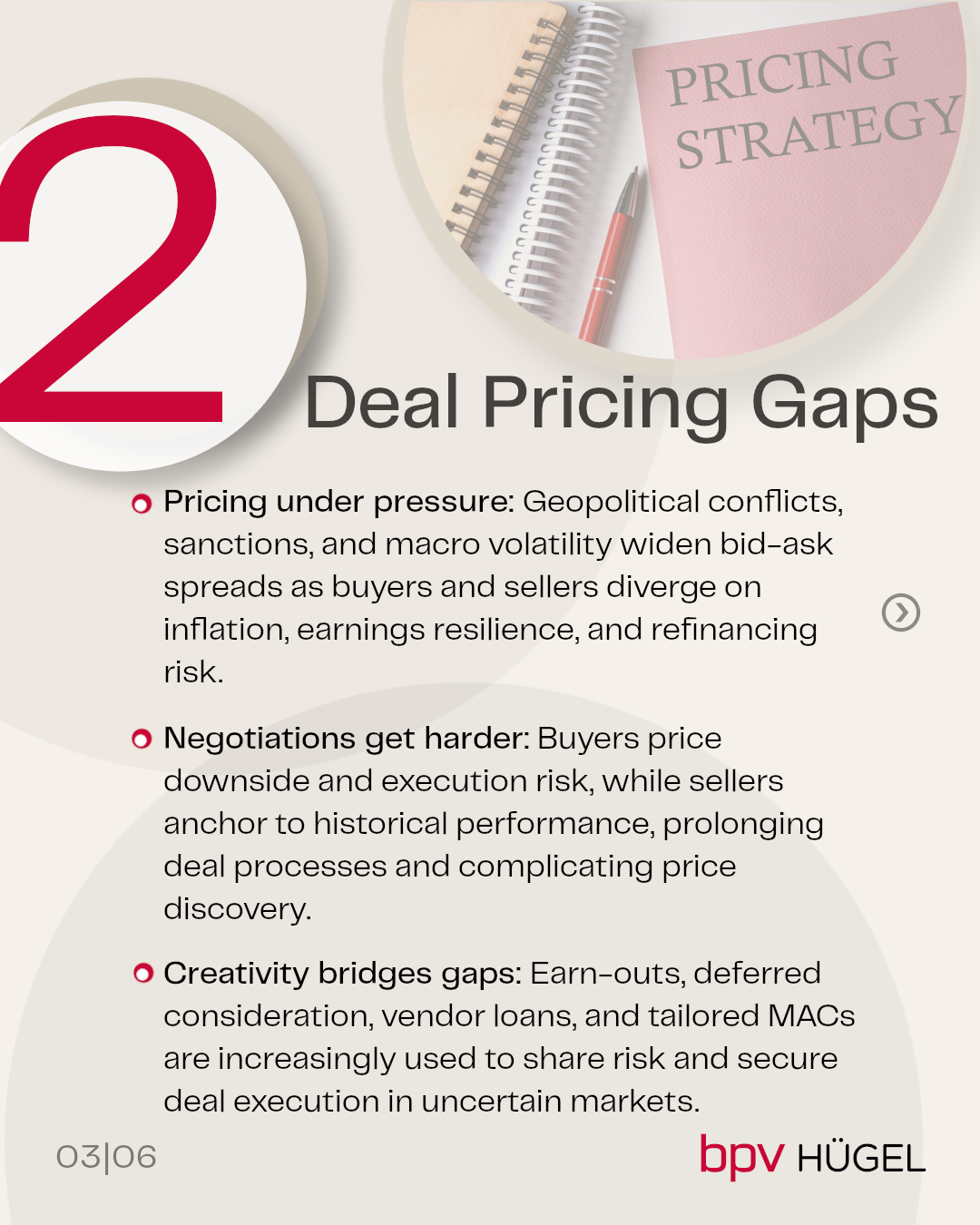
2. Deal Pricing Gaps
Geopolitical conflicts, sanctions regimes, trade frictions, and broader macroeconomic volatility have significantly increased global uncertainty, fuelling higher inflation expectations, elevated risk premia, and more volatile financing conditions. As a result, valuation expectations between buyers and sellers increasingly diverge, leading to wider bid‑ask spreads and more difficult price discovery processes.
In M&A transactions, this valuation gap is often driven by differing assumptions on future earnings resilience, cost inflation, supply chain stability, regulatory exposure, and refinancing risk. Buyers tend to price in downside scenarios and execution risk, while sellers continue to anchor valuations to historical performance or pre‑crisis multiples. This mismatch frequently complicates negotiations and prolongs deal processes.
To bridge these gaps, parties are increasingly relying on structural pricing mechanisms, such as earn‑outs, deferred consideration, vendor loans, or contingent value rights, shifting part of the valuation risk into the post‑closing period. In parallel, greater emphasis is being placed on locked‑box protections, adjustment‑free pricing, and tailored MAC clauses to allocate macroeconomic and geopolitical risks more precisely. Overall, pricing creativity and risk‑sharing structures have become central tools to achieving deal execution in an environment of persistent uncertainty.
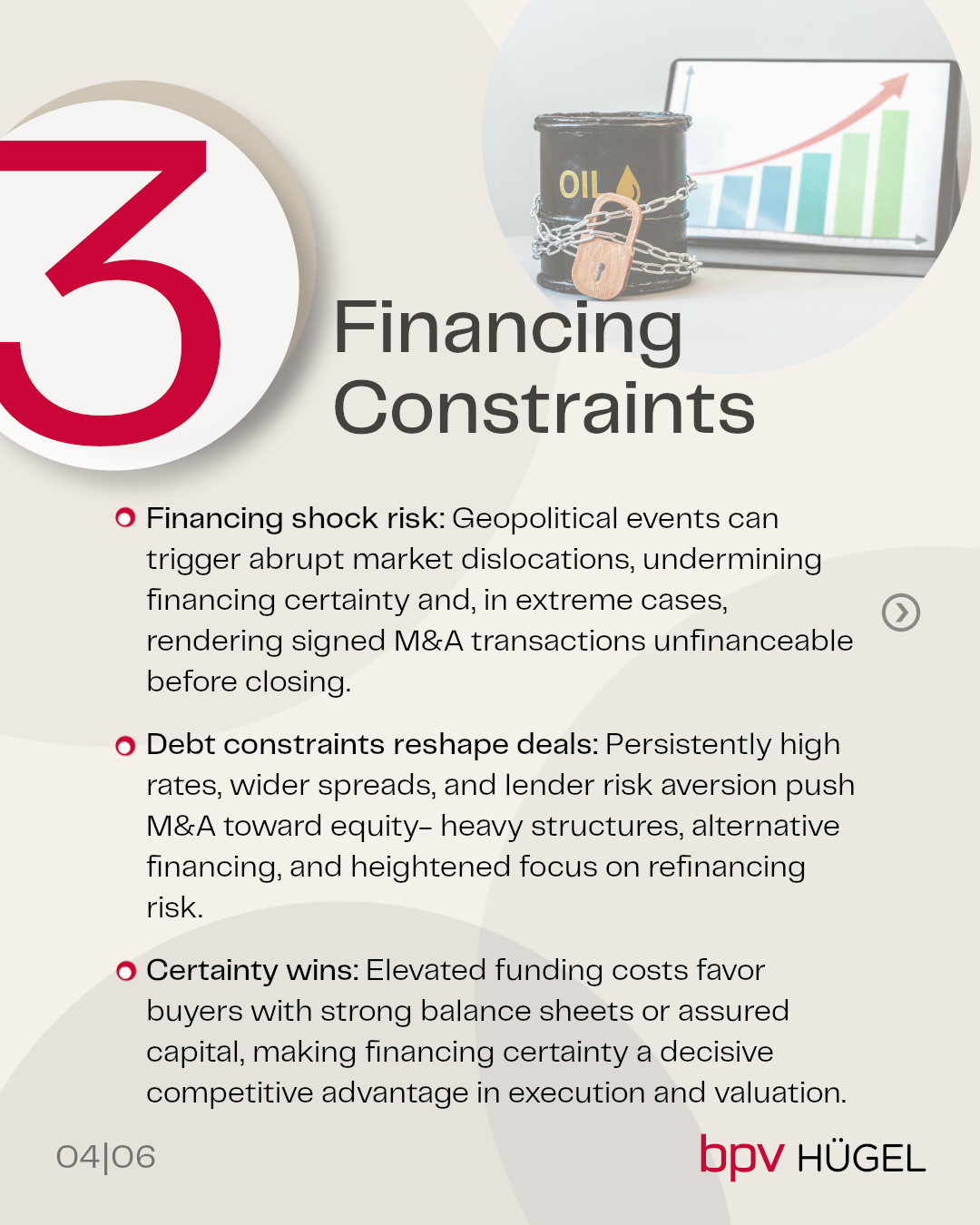
3. Financing Constraints
Geopolitical tensions and conflict‑driven shocks can trigger sudden market dislocations, as recently evidenced by energy price spikes following developments in the Iran conflict. Such events exacerbate recession fears, reinforce risk‑off sentiment, and materially reduce predictability across capital markets – posing a structural challenge to M&A activity. In extreme cases, transactions that were fully financed at signing may become partially or entirely unfinanceable before closing.
At the same time, sustained inflationary pressures and geopolitical uncertainty reduce the likelihood of rapid or substantial interest‑rate cuts. Higher base rates, wider credit spreads, and increased lender risk aversion have significantly tightened leveraged finance markets.
As a result, M&A transactions increasingly require equity‑heavy capital structures, alternative financing solutions, or staged investments. For private equity buyers in particular, reduced leverage capacity directly impacts returns and deal velocity, contributing to slower deployment and more selective investment strategies. In parallel, refinancing risk – especially for targets with near‑term maturities – has emerged as a critical diligence focus.
Overall, elevated financing costs and constrained debt availability not only suppress valuation levels but also shift M&A dynamics in favor of buyers with strong balance sheets, proprietary capital, or assured funding – making certainty of financing a decisive competitive advantage in execution.
4. Risk Allocation
In periods of heightened geopolitical tension, risk allocation becomes a central negotiating battleground in M&A transactions. Elevated macroeconomic, regulatory, and market volatility increase the likelihood of adverse developments occurring between signing and closing, prompting parties to reassess how risks are contractually allocated – often even in markets that otherwise favor sellers.
Buyers increasingly seek enhanced downside protection through conditionality and termination rights, in particular business‑specific or market‑wide MAC clauses, which are frequently closely linked to acquisition financing conditions. Greater scrutiny is placed on interim operating covenants, leakage protections, and closing conditions to ensure the value of the target is preserved throughout extended signing‑to‑closing periods. At the same time, sellers aim to limit open‑ended exposure by tightening materiality thresholds and narrowing MAC carve‑outs.
Challenging market conditions may also materially affect the availability and scope of warranty & indemnity (W&I) insurance. Insurers may respond to increased uncertainty by excluding certain risks (e.g. sanctions, cyber, supply chain disruption, or geopolitical exposure), raising premiums, or reducing coverage limits. Where W&I coverage is constrained or unavailable, buyers may seek greater seller backing, including escrow arrangements, deferred consideration, indemnities for specific risks, or parent or bank guarantees.
Overall, deal execution in volatile environments increasingly hinges on sophisticated risk‑sharing mechanisms. Clear and balanced allocation of geopolitical, regulatory, and market risks has become critical not only for pricing and documentation, but for bridging expectation gaps and maintaining transaction certainty in unstable conditions.
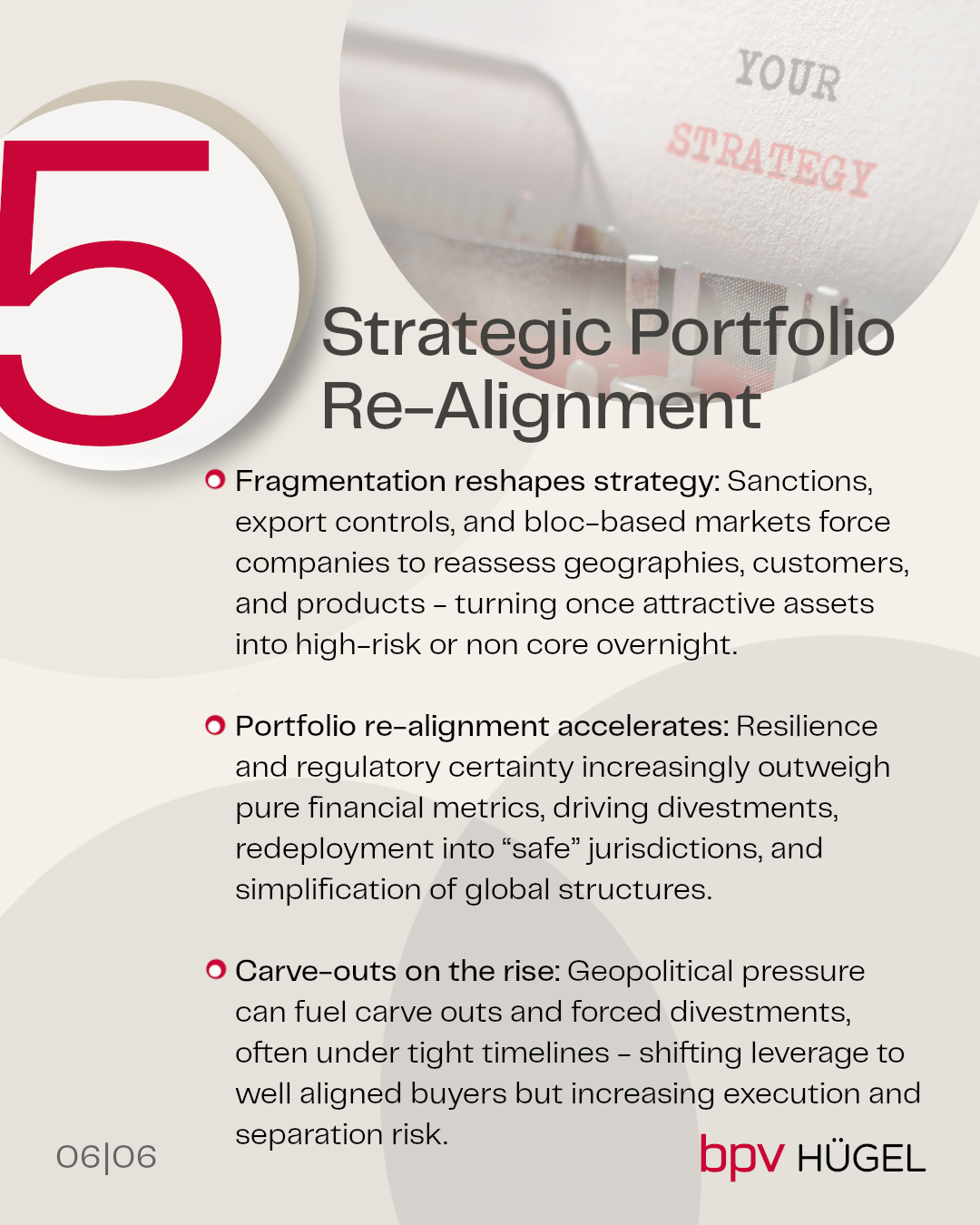
5. Strategic Portfolio Re‑Alignment
Expanding sanctions regimes, export controls, secondary sanctions exposure, and the growing fragmentation of global markets into “friend‑shoring” and “bloc‑based” systems are forcing companies to fundamentally reassess where and how they can legally, operationally, and reputationally conduct business. Entire geographies, customer segments, suppliers, or product lines can become non‑core or high‑risk almost overnight – even where they remain commercially attractive in isolation.
These dynamics are accelerating strategic portfolio re‑alignment across industries. Companies are increasingly prioritizing resilience, regulatory certainty, and geopolitical alignment over purely financial metrics. As a consequence, businesses may divest assets with elevated sanctions exposure, redeploy capital into “safe” jurisdictions, or simplify complex international structures to reduce compliance and reputational risk.
For M&A markets, this has translated into a marked increase in carve‑out transactions, spin‑offs, disentanglements, and forced or time‑pressured divestments. Where sellers face regulatory deadlines, sanctions risk, or political pressure to exit certain markets, transactions may occur under compressed timelines. In such situations, buyers – particularly those with sectoral expertise, political alignment, or operational capabilities – may gain significant leverage in pricing and structuring, including the ability to demand extensive transitional services, downside protection, or discounted valuations.
At the same time, complex carve‑outs increase execution risk, necessitating greater focus on separation planning, stranded cost allocation, IP and data localization, and regulatory approvals. Overall, geopolitical fragmentation has turned M&A into a key strategic tool for portfolio reshaping, while also amplifying asymmetries between motivated sellers and opportunistic buyers.
The summary (as a PDF).


 Teilen
 Twittern
 Teilen