13 February 2026 – need2know
In our first M&A Spotlight edition (Vol. 1), bpv Huegel PE/M&A partner Michal Dobrowolski highlights the “Top 5 Trends to Watch in 2026” – key developments that will define where M&A deals are headed this year and how they will shape opportunities for investors, corporates, and the broader market.
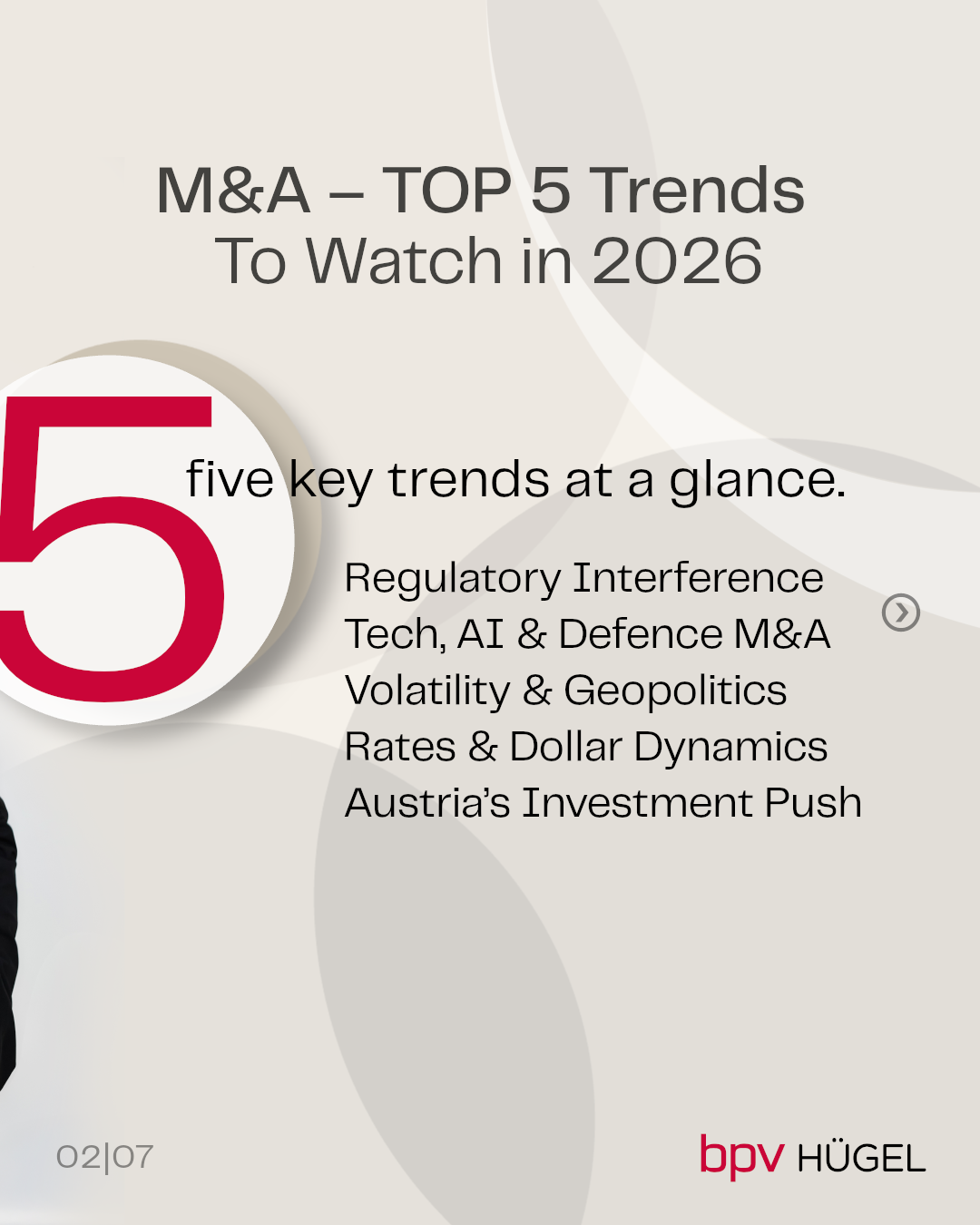
Five key trends at a glance.
- Regulatory Interference
- Tech|AI, Defence and Distressed M&A
- Market Volatility and Geopolitical Uncertainty
- Interest Rates and the Decline of the Dollar
- Austria’s Investment and Innovation Package
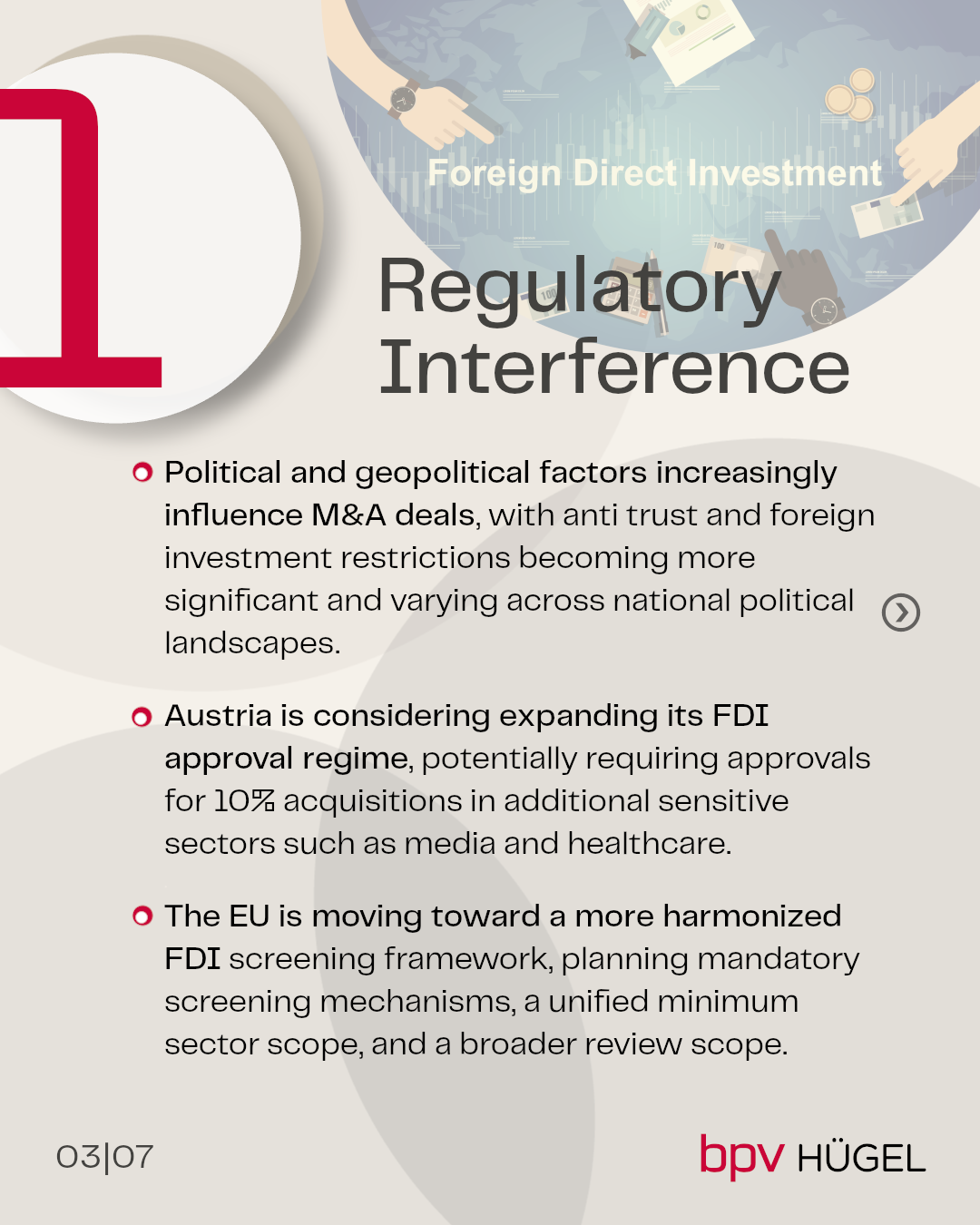
1. Regulatory Interference
- Political and geopolitical factors increasingly influence M&A deals, with anti‑trust and foreign‑investment restrictions becoming more significant and varying across national political landscapes.
- Austria is considering expanding its FDI approval regime, potentially requiring approvals for 10% acquisitions in additional sensitive sectors such as media and healthcare.
- The EU is moving toward a more harmonized FDI screening framework, planning mandatory screening mechanisms, a unified minimum sector scope, and a broader review scope.
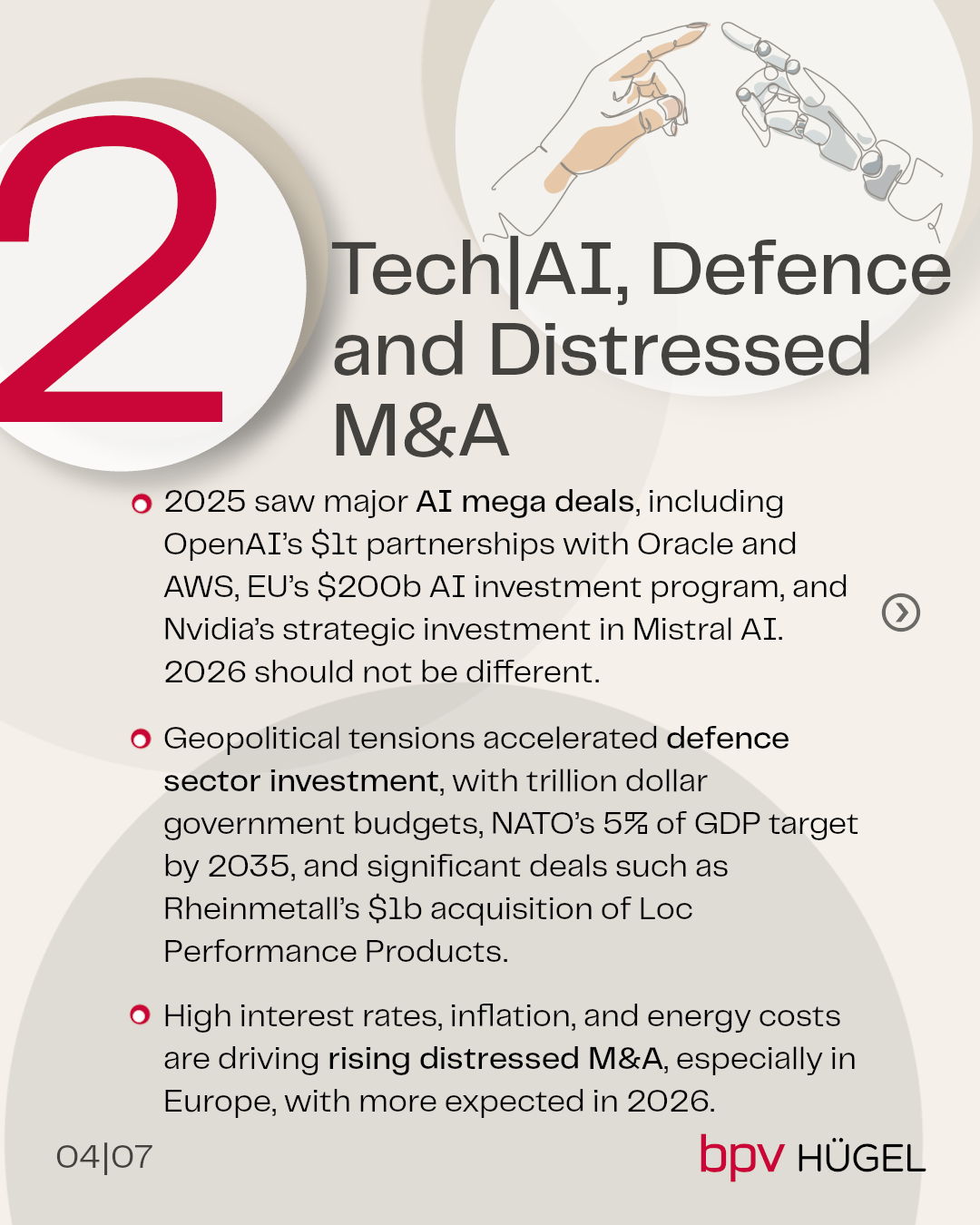
2. Tech|AI, Defence and Distressed M&A
- 2025 saw major AI mega‑deals, including OpenAI’s USD 1 trillion partnerships with Oracle and AWS, the EU’s USD 200 billion AI investment program, and Nvidia’s strategic investment in Mistral AI. 2026 should not be different.
- Geopolitical tensions accelerated defence‑sector investment, with trillion‑dollar government budgets, NATO’s 5%‑of‑GDP target by 2035, and significant deals such as Rheinmetall’s USD 1 billion acquisition of Loc Performance Products.
- High interest rates, inflation, and energy costs are driving rising distressed M&A, especially in Europe, with more expected in 2026.
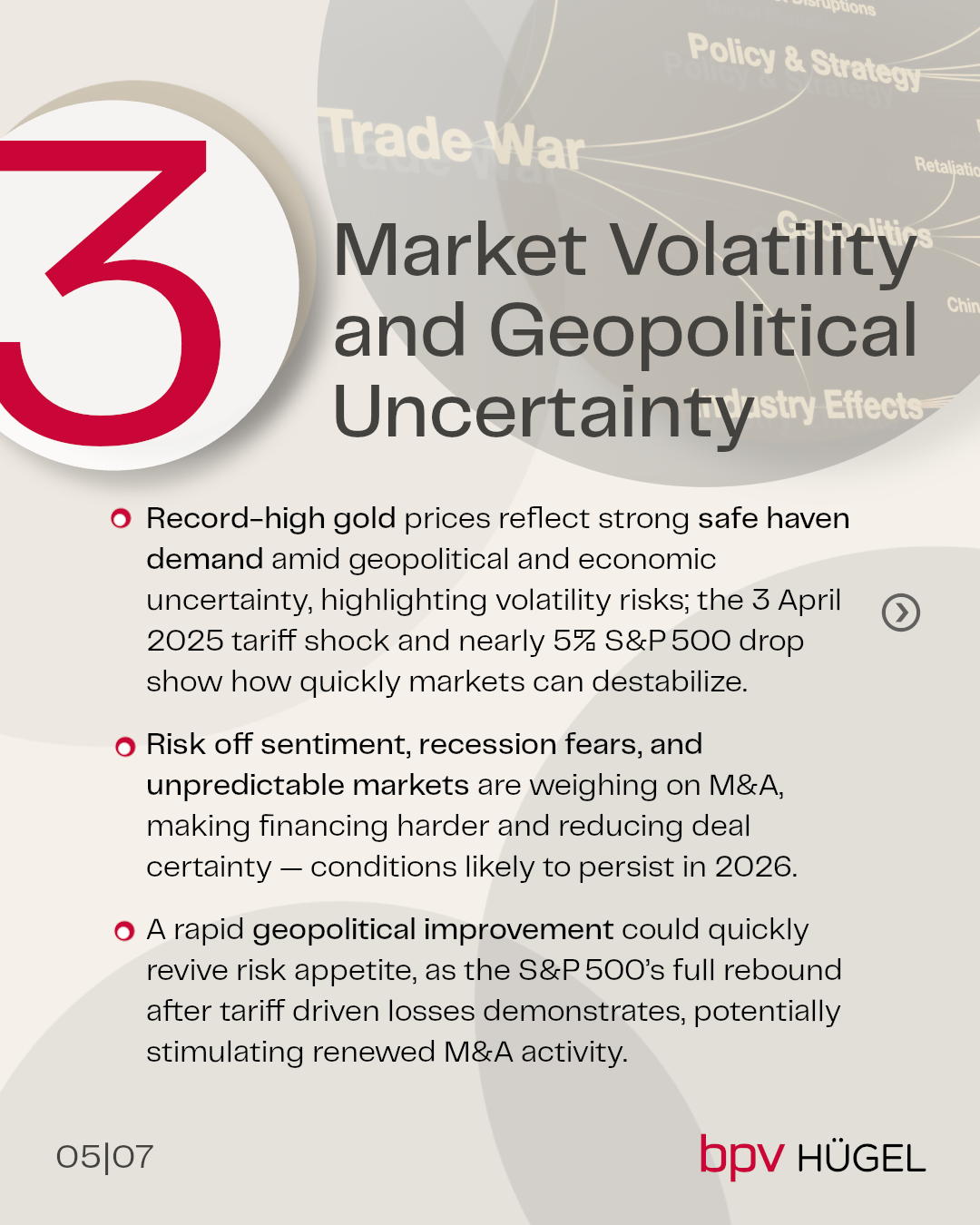
3. Market Volatility and Geopolitical Uncertainty
- Record-high gold prices reflect strong safe‑haven demand amid geopolitical and economic uncertainty, highlighting volatility risks; the 3 April 2025 tariff shock and nearly 5% S&P 500 drop show how quickly markets can destabilize.
- Risk‑off sentiment, recession fears, and unpredictable markets are weighing on M&A, making financing harder and reducing deal certainty — conditions likely to persist in 2026.
- A rapid geopolitical improvement could quickly revive risk appetite, as the S&P 500’s full rebound after tariff‑driven losses demonstrates, potentially stimulating renewed M&A activity.
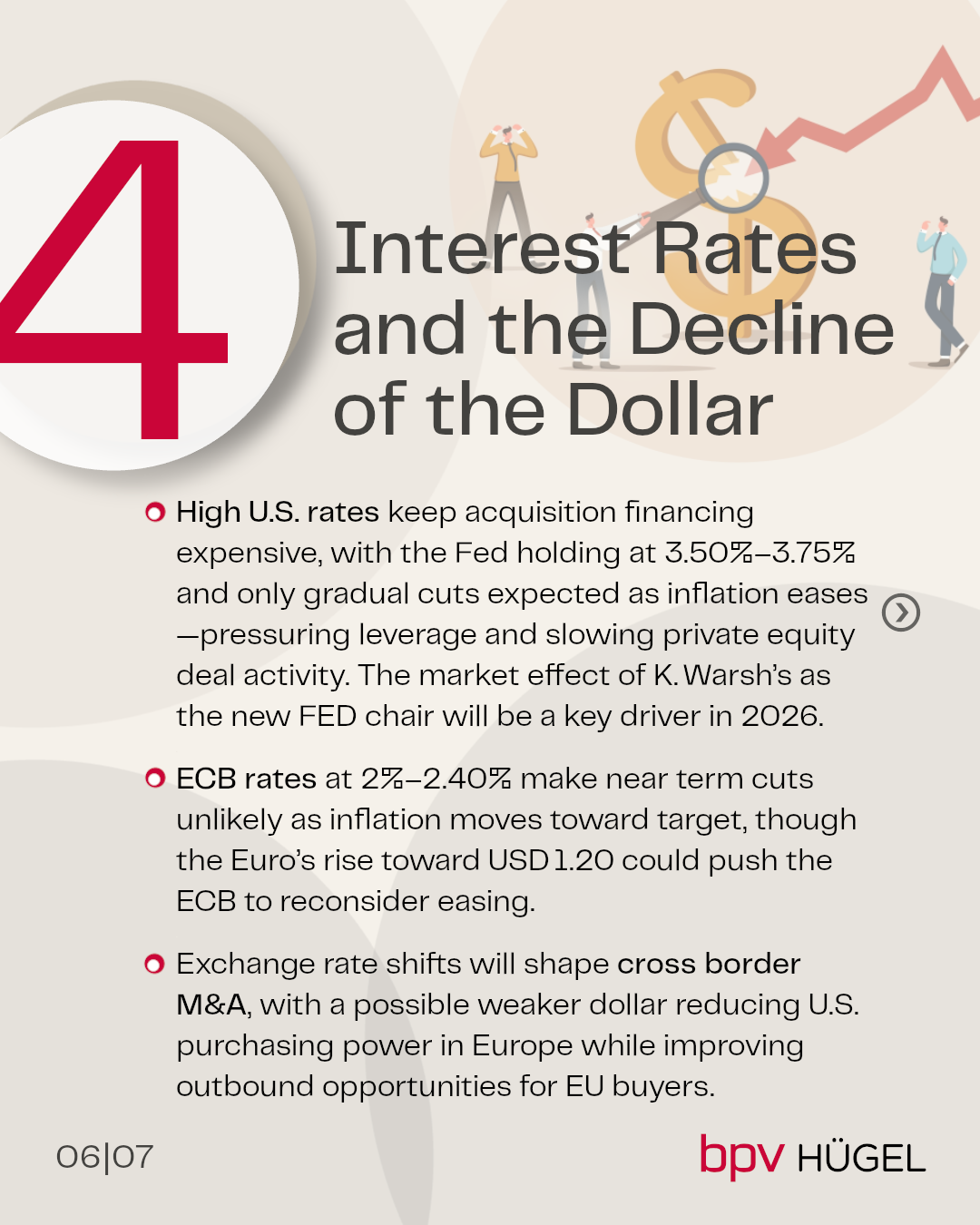
4. Interest Rates and the Decline of the Dollar
- High U.S. rates keep acquisition financing expensive, with the Fed holding at 3.50%–3.75% and only gradual cuts expected as inflation eases—pressuring leverage and slowing private‑equity deal activity. The market effect of K. Warsh’s as the new FED chair will be a key driver in 2026.
- ECB rates at 2%–2.40% make near‑term cuts unlikely as inflation moves toward target, though the Euro’s rise toward USD 1.20 could push the ECB to reconsider easing.
- Exchange‑rate shifts will shape cross‑border M&A, with a possible weaker dollar reducing U.S. purchasing power in Europe while improving outbound opportunities for EU buyers.
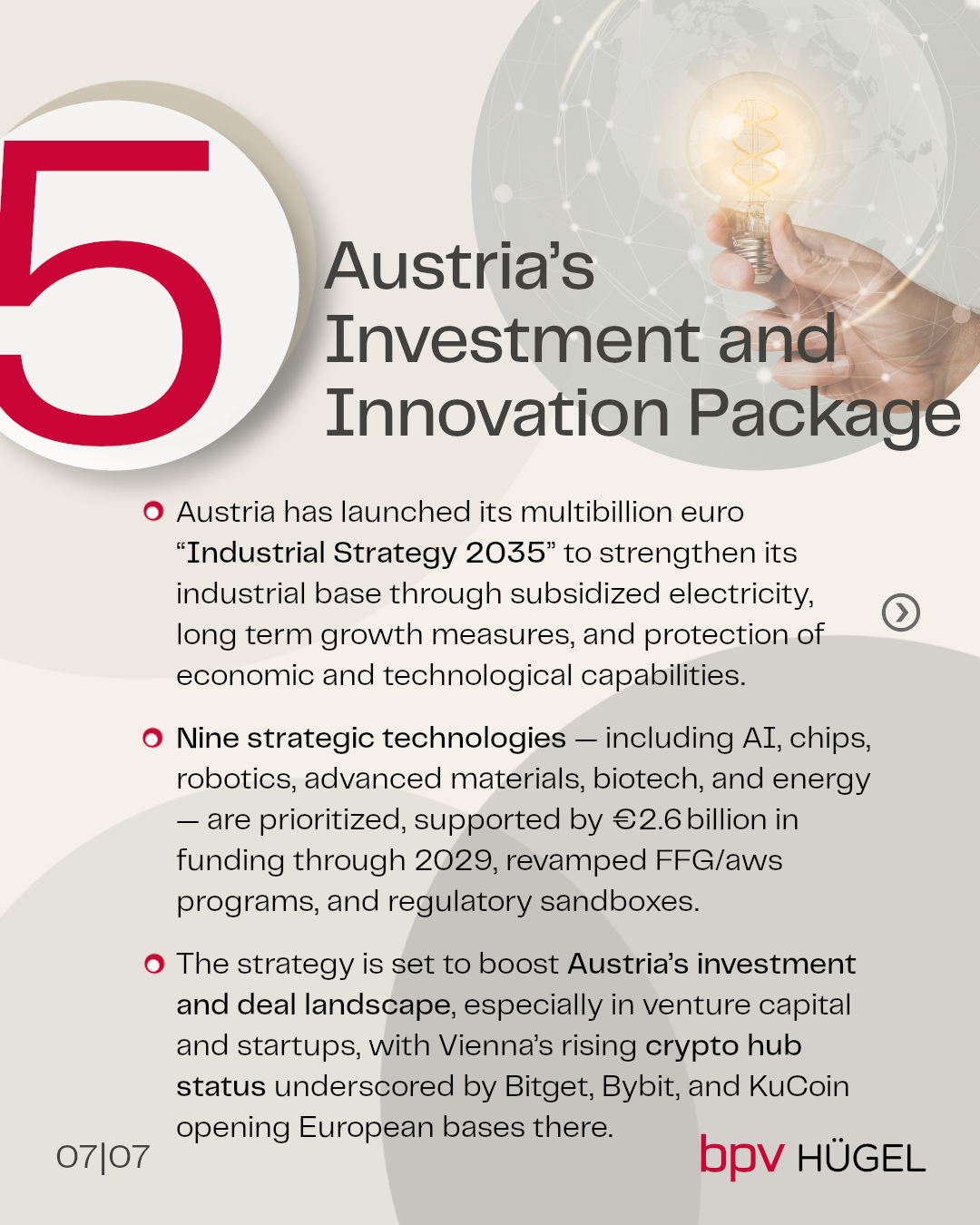
5. Austria’s Investment and Innovation Package
- Austria has launched its multibillion‑euro “Industrial Strategy 2035” to strengthen its industrial base through subsidized electricity, long‑term growth measures, and protection of economic and technological capabilities.
- Nine strategic technologies — including AI, chips, robotics, advanced materials, biotech, and energy — are prioritized, supported by €2.6 billion in funding through 2029, revamped FFG/aws programs, and regulatory sandboxes.
- The strategy is set to boost Austria’s investment and deal landscape, especially in venture capital and startups, with Vienna’s rising crypto hub status underscored by Bitget, Bybit, and KuCoin opening European bases there.
The summary (as a PDF).


 Teilen
 Twittern
 Teilen