Der EuGH sorgt für Klarheit beim Alleinvertrieb – und verschärft die Anforderungen an exklusive Vertriebsmodelle im Binnenmarkt

Stefan Holzweber und Konstantin Gründler aus dem Kartellrechtsteam fassen die wichtigsten Punkte zusammen:

? Der EuGH sorgt für Klarheit beim Alleinvertrieb – und verschärft die Anforderungen an exklusive Vertriebsmodelle im Binnenmarkt.

Der EuGH hat am 8. Mai 2025 (C-581/23 – Beevers Kaas BV) eine Grundsatzentscheidung zur Zulässigkeit von Alleinvertriebsvereinbarungen gefällt – mit weitreichenden Folgen für die Vertriebspraxis im EU-Binnenmarkt.

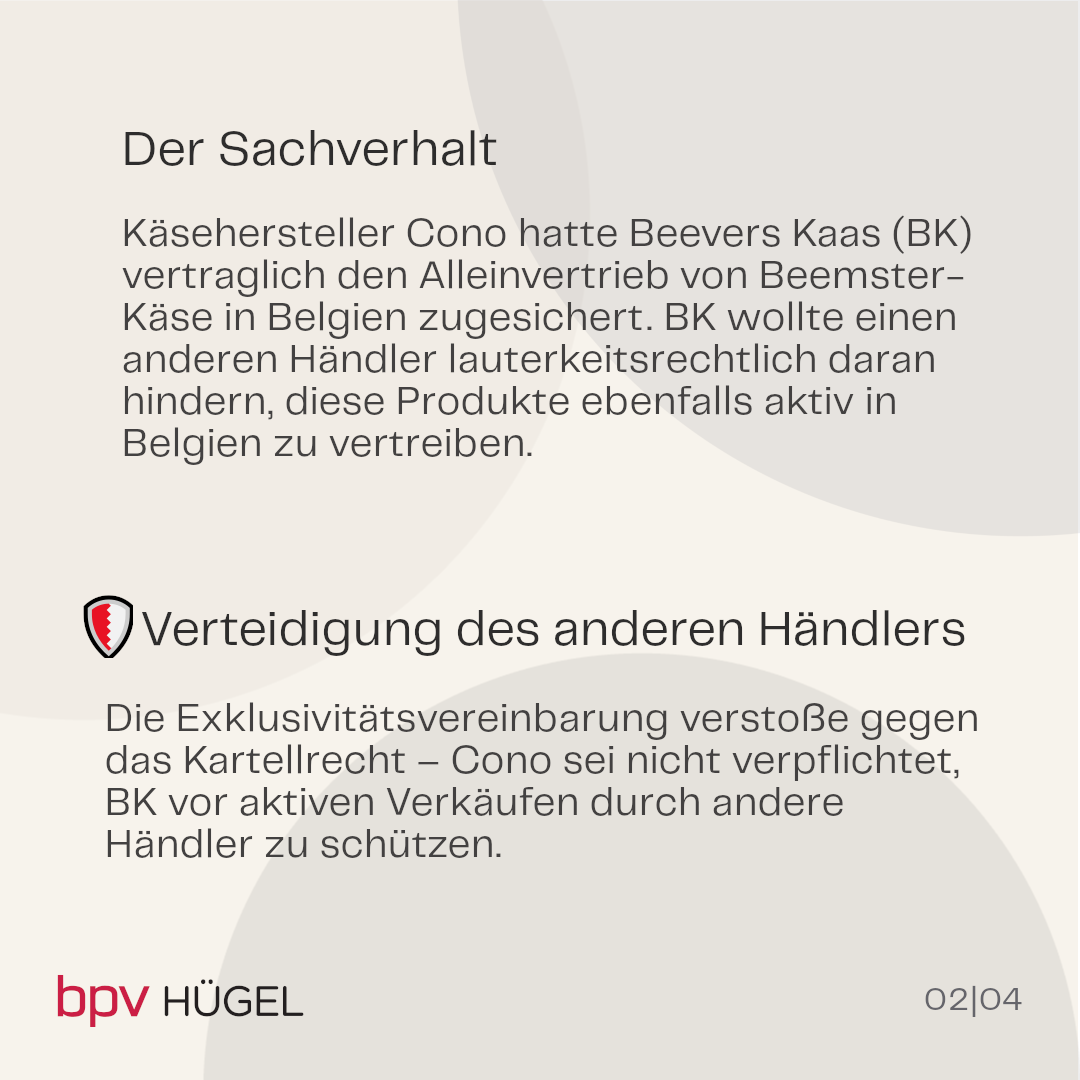
Der Sachverhalt:
Käsehersteller Cono hatte Beevers Kaas (BK) vertraglich den Alleinvertrieb von Beemster-Käse in Belgien zugesichert. BK wollte einen anderen Händler lauterkeitsrechtlich daran hindern, diese Produkte ebenfalls aktiv in Belgien zu vertreiben.

?️ Verteidigung des anderen Händlers:
Die Exklusivitätsvereinbarung verstoße gegen das Kartellrecht – Cono sei nicht verpflichtet, BK vor aktiven Verkäufen durch andere Händler zu schützen.

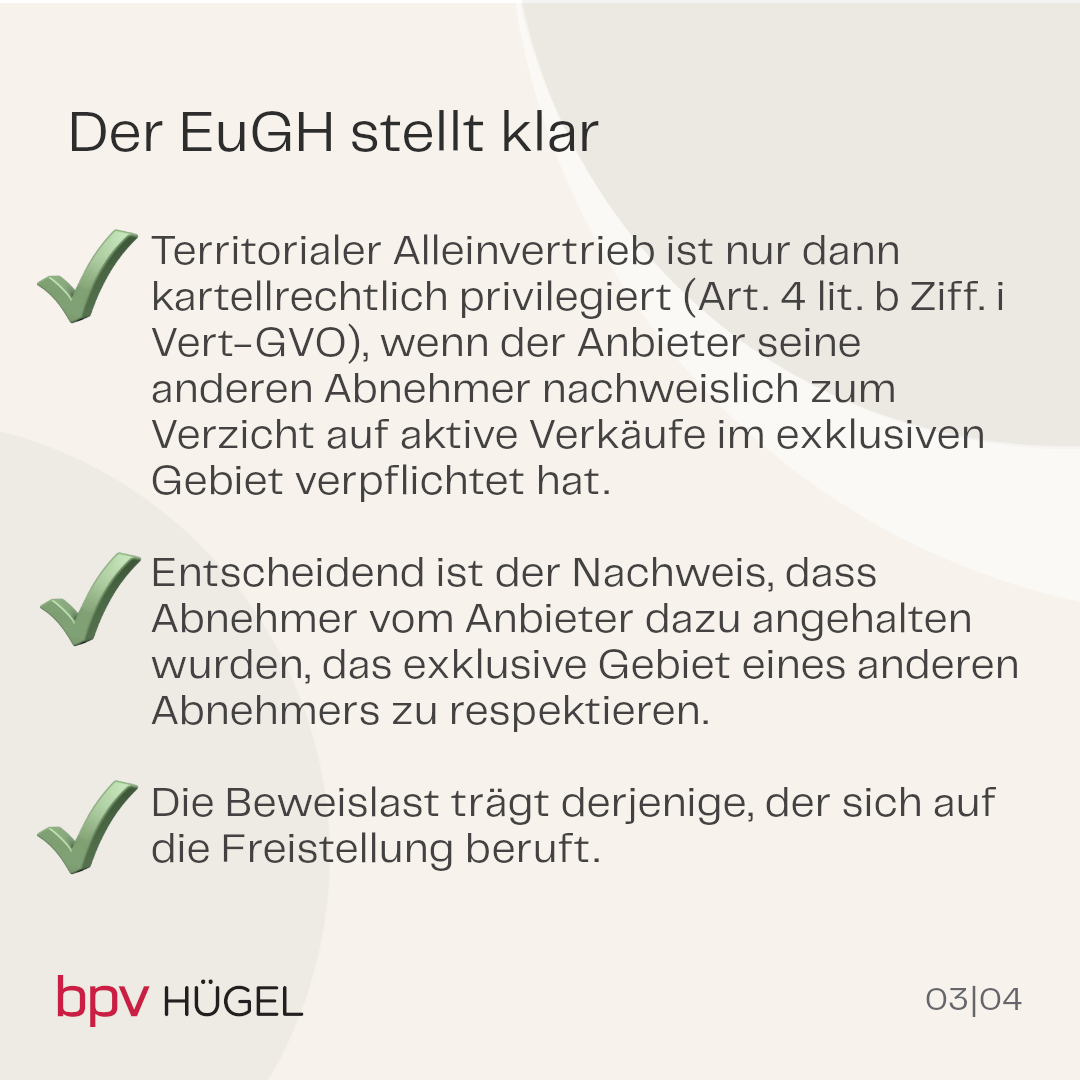
Der EuGH stellt klar:

  • Territorialer Alleinvertrieb ist nur dann kartellrechtlich privilegiert (Art. 4 lit. b Ziff. i Vert-GVO), wenn der Anbieter seine anderen Abnehmer nachweislich zum Verzicht auf aktive Verkäufe im exklusiven Gebiet verpflichtet hat.
  • Entscheidend ist der Nachweis, dass Abnehmer vom Anbieter dazu angehalten wurden, das exklusive Gebiet eines anderen Abnehmers zu respektieren.
  • Die Beweislast trägt derjenige, der sich auf die Freistellung beruft.

? Das Urteil bedeutet für die Praxis:
Wer auf Alleinvertrieb setzt, muss auch den aktiven Vertrieb anderer vertraglich unterbinden.

Die Zusammenfassung (als PDF)


Our use of cookies

We use necessary and functionality cookies to make our site work. We only use analytics cookies to improve our website if you enable them. By using this tool for individual settings of the cookies, we will send a cookie to your device to remember your preferences.

For more detailed information about the cookies we use, see our Cookies Policy.

Necessary Cookies Necessary cookies enable core functionality such as security, network management, and accessibility. You may disable these by changing your browser settings, but this may affect the website functions.

Functionality Cookies

Functionality cookies allow users to customise how a website looks for them: they can remember usernames, language preferences and regions. We use functionality cookies for storing your user preferences and remembering if you have been to the site before so that messages intended for first-time users are not displayed to you. These cookies do not collect information about you that could be used for marketing purposes and do not remember where you have been on the Internet.

You may disable these cookies with the button, but you should be aware that any preferences will be lost and you will have to make them again on your next visit. It is also possible that the website will not work properly or you will lose some functionality.

Analytics cookies (including US providers)

"Web analytics cookies" collect aggregated information about user behaviour to improve our website. We would like to use such cookies from Google Analytics to improve our website by collecting and evaluating information about the use of our website. The provider of Google Analytics is Google LLC, which is based in the USA. The USA is not certified by the European Court of Justice as having an adequate level of data protection. In particular, there is a risk that your data may be accessed by US authorities for control and monitoring purposes and that no effective legal remedies are available against this. By activating the button under "Web analytics cookies (including from US providers)", you agree that we may set these cookies and that you also agree to the transfer of data to the USA. You can revoke your consent at any time via the cookie settings on our website.